
“Humans turned themselves into masters only to find a new way to become slaves.”
— Gunther Anders, The Obsolescence of the Human
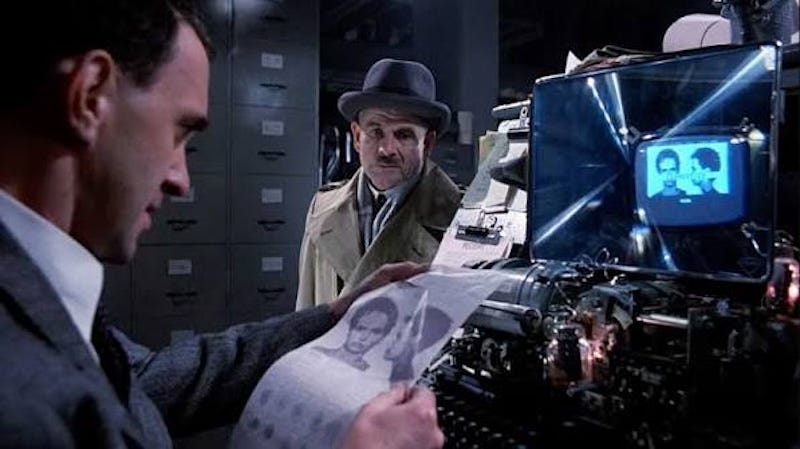
The society depicted in Terry Gilliam’s 1985 movie Brazil is industrial in its aesthetics and institutional in its metaphysics, bureaucratic beyond all hope. Gilliam’s original title for the project was 1984½, in homage to both George Orwell’s novel Nineteen Eighty-Four and Federico Fellini’s film 8½, which share the concerns of the mechanization of modern life.1 They’re all about all the ways we are enslaved by our machines, our computers, our phones, surveilled by the eyes and ears of our technology.
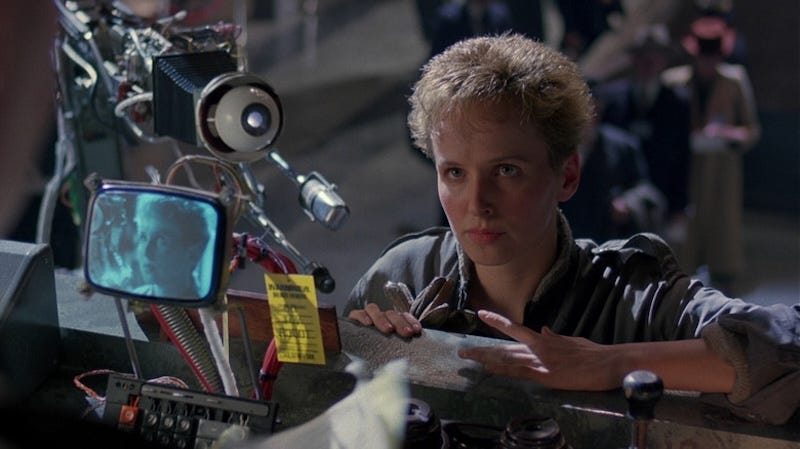
“Some of the technology was a deliberate mixture of the futuristic and the Victorian,” says Gilliam. “There’s a lot of growing up in America in the forties: progress and the utopian vision were always there, with technology as the answer to all of our needs.”2 The movie’s ontology operates atop a machine metaphor.3 Unexpected breakdowns, routine repairs, and replacing parts—hydraulic hoses, pneumatic tubes, and other analog accoutrements—make up a lot of the concerns of the characters in Brazil.
“The most virulent form of philosophical technolibertarianism is a kind of scary, psychologically brittle, prepolitical autism. It’s an inability to reconcile the demands of being individual with the demands of participating in society… these technolibertarians make a philosophy out of a personality defect.”
— Paulina Borsook, Cyberselfish
Gilliam adds, “There was a collective dream of progress and a centralized belief in the perfectibility of man [sic] — either through technology or fascism, which effectively amounted to the same thing.”4 Brazil is a vision of the 1980s through the lens of the 1940s, just like Orwell’s, but unlike the panopticon of Nineteen Eighty-Four, Brazil focusses further on the desire for distraction, to escape from such technological fascism through fantasy.5 The film takes its surveillance society as a given and tries to find a way out through human imagination.

End Times Fascism, and the Fight for The Living World (FSG, 2026) by Naomi Klein and Astra Taylor presents a new attempt at tackling this technologically enabled, creeping fascism. Both of these authors have been described as North Stars for the state of things: Klein’s No Logo (1999) and The Shock Doctrine (2007) and Taylor’s The People’s Platform (Picador, 2015) and The Age of Insecurity (House of Anansi Press, 2023) made many implicit ills and evils in our culture explicit, turning latent aches into blatant sharp pains. Their work is as enraging as it is engaging.
“Fascism is a counter-revolution against a revolution that never took place.”
— Ignazio Silone
And the rage is key. As the technologist Jaron Lanier has pointed out, “Social media is biased, not to the Left or the Right, but downward,”6 adding that it’s “neither liberal nor conservative; it is just pro-paranoia, pro-irritability, and pro-general assholeness.”7 Similarly Klein and Taylor frame fascism as capitalism’s “most ferocious” form, “a way of making sure that the public anger that wells up during times of deep crisis is directed downward at the vulnerable rather than upward at the system itself.” They keep that rage pointed down, urging us to “take back control”—not from oligarchs and politicians but from immigrants and minorities, with whom we have far more in common. “All over the world,” they write, “fascist forces are directing anger downward, at the people least responsible for our societal troubles, and persuading electorates that they can no longer afford to care about anyone but themselves, their families, and the neighbors who look and think like them.”8
Whether their “plans take the form of heavenly ascension, earthly bunkers and fortressed nations, or fantasies of colonized space or merging with machines. Instead of improving conditions on Earth, end times fascists are plotting their escape, oblivious to all that’s worth saving.”9 In the meantime, they’re fracking our attention with social media, fake outrage, and AI, the latter of which is especially concerning. Klein and Taylor write, “Executives who warn that AI might destroy the world also claim that they can’t slow down because China might outpace them—as though a race off a cliff is a race worth winning.”10
“Right now, the earth is full of refugees, human and not, without refuge.”
— Donna Haraway, Staying With the Trouble
In her book, Staying With the Trouble (Duke University Press, 2016), Donna Haraway writes, “I think our job is to make the Anthropocene as short/thin as possible and to cultivate with each other in every way imaginable epochs to come that can replenish refuge.”11 We tire of the myopic lockstep of election cycles and quarterly reports, the kind of short-term thinking that now only serves the technologically-enabled oligarchs and fascists, takes most of the resources, and leaves the rest as refuse. We do indeed need “to escape through human imagination,” but we shouldn’t be trying to escape our earth, our country, our state, city, neighborhood, or body. We are all embodied and embedded in these layers, limited by the boundaries of each. As Klein and Taylor write, “End times fascism is a symptom of all the ways capitalism is pushing beyond our planet’s limits.” We should be trying to escape the mindset that seeks the extraction of every finite resource. We should be trying to escape the mindset that sees us as lesser and leaves us with less. We should be trying to escape into a future of community and cooperation with our neighbors.
Klein and Taylor write,
History isn’t linear but it also doesn’t repeat on a loop, circling back to the same place over and over again. Rather, it moves in more of a spiral, pushing to places that feel familiar but are fundamentally different. The accumulated weight of what came before collides with new, unpredictable developments.12
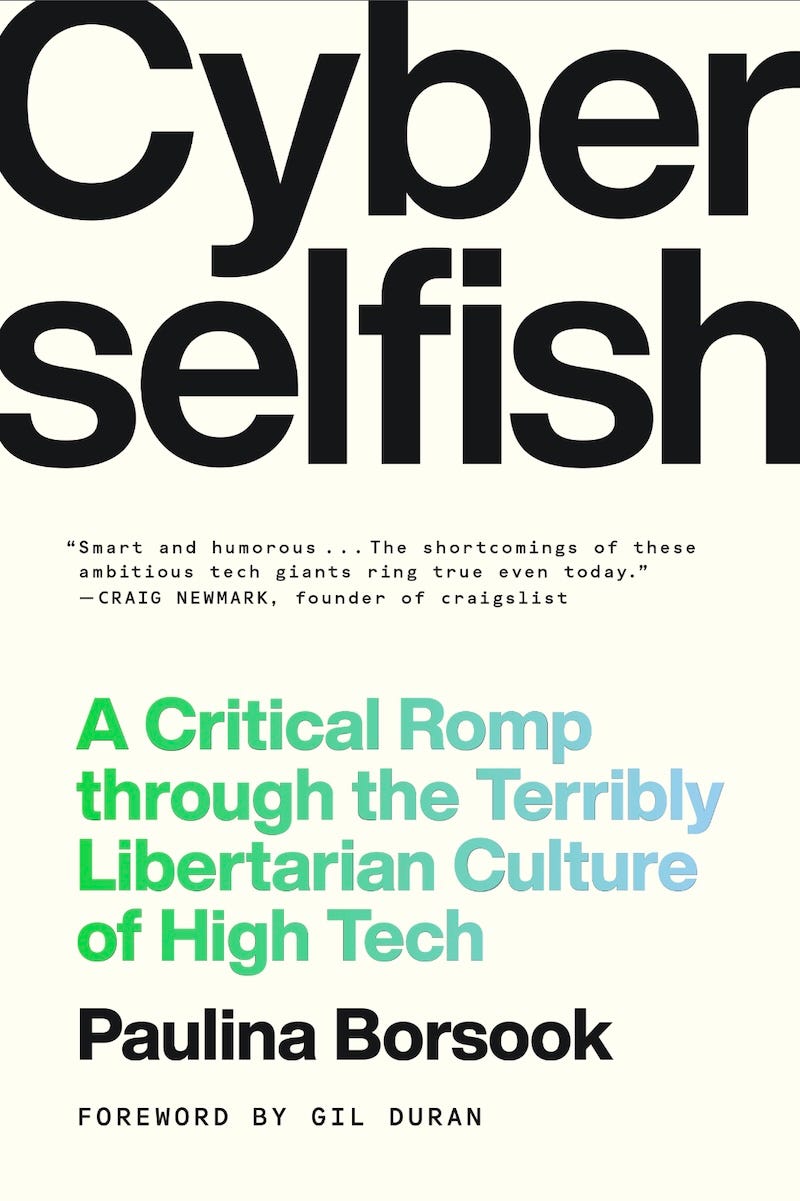
Paulina Borsook explored some of these “unpredictable developments” in her 2000 book, Cyberselfish: A Critical Romp Through the Terribly Libertarian Culture of High Tech (PublicAffairs, 2000), which was recently rereleased (Tin House/Zer0 Books, 2026) because as our centrifugal force widens the spiral, it remains as relevant as ever. That’s good for Borsook and her insights, but not so much for the rest of us. In a recent profile in WIRED, Tommy Craggs writes, “Everything Borsook would later write as a journalist covering the industry—the frisky pieces for Salon and Suck, the weightier profiles for WIRED, every barbed word of Cyberselfish—seemed to flow from a simple imperative drawn from her experience: never lose sight of the human in the machine.”13 She aptly calls this approach “agonized humanism,”14 a critical stance that still cares deeply about its embedded human subjects.
“There was a collective dream of progress and a centralized belief in the perfectibility of man [sic] — either through technology or fascism, which effectively amounted to the same thing.”
— Terry Gilliam
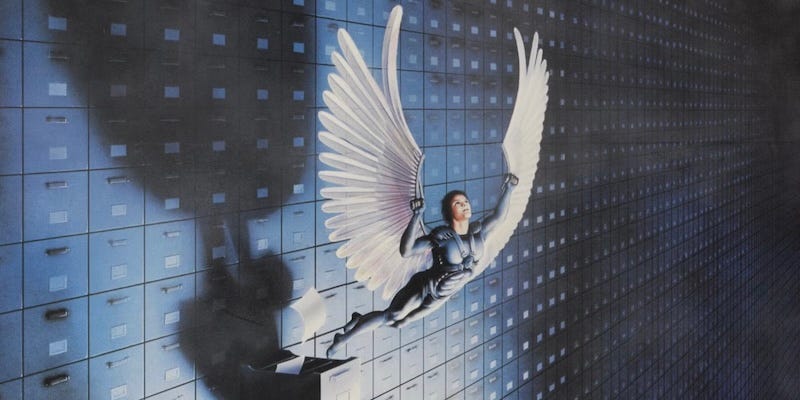
“[T]echnology is just like indoor plumbing or electricity: it’s infrastructure, not magic,” Borsook wrote in 2015, adding “software was a human artifact; that is, I began to be able to think the way the creators […] thought… The dyer’s hand, the design sensibility, the cognitive blind spots: all evident and all human artifacts. Technology is idiosyncratic like the humans who devise it and the people who make it are just people.”15 We would do well to remember those people have biases and agendas.16 We would do well to remember that they make our information infrastructure in their own likeness, codified as policy and politicized as code.
“Fascism is capitalism with bared teeth.”
— Naomi Klein and Astra Taylor, End Times Fascism
Notes:
1 Bruce R. Burningham, Tilting Cervantes: Baroque Reflections on Postmodern Culture, Nashville, TN: Vanderbilt University Press, 2008.
2 Quoted in Ian Christie, Gilliam on Gilliam, London: faber & faber, 1999, 129.
3 Barry Brummett writes, “Several references within the film make it clear that the characters regard their society as if it were a machine.”; Brummett, Rhetoric of Machine Aesthetics, 1999, 122; Michel de Certeau defines a “culture” as “systems of operational combination”; de Certeau, The Practice of Everyday Life, Oakland, CA: University of California Press, 1984, xi.
4 Quoted in Christie, 1999, 145; Jeffrey Melton and Eric Sterling describe the world of Brazil as “an authoritarian nightmare that in every way discourages human aspiration beyond the desire for comfort and commodities.”; Melton & Sterling, “The Subversion of Happy Endings in Terry Gilliam’s Brazil,” In Birkenstein, Froula, & Randell (eds.), The Cinema of Terry Gilliam, New York: Wallflower Press, 2013, 69.
5 Melton & Sterling, 2013; Most of this first section is lifted from my book The Medium Picture; See Roy Christopher, The Medium Picture, Athens, GA: University of Georgia Press, 2025.
6 Jaron Lanier, Ten Arguments for Deleting Your Social Media Accounts Right Now, New York: Henry Holt, 2018, 24.
7 Ibid., 115.
8 Naomi Klein & Astra Taylor, End Times Fascism, and the Fight for The Living World, New York: Farrar, Straus and Giroux, 2026.
9 Klein & Taylor, 2026; See also Mark Dery, The Pyrotechnic Insanitarium, New York: Grove Press, 1999; Douglas Rushkoff, The Survival of the Richest, New York: W.W. Norton & Co., 2022; and Roy Christopher, Post-Self: Journeys Beyond the Human Body, London: Repeater Books, 2025.
10 Klein & Taylor, 2026.
11 Donna Haraway, Staying With the Trouble, Durham, NC: Duke University Press, 2016.
12 Klein & Taylor, 2026.
13 Tommy Craggs, “Who Killed Paulina Borsook’s Career?” WIRED, September 25, 2026.
14 Quoted in Craggs, 2026.
15 Quoted in Geert Lovink, “Cyberselfish, 15 Years After,” Public Affairs, 2015.
16 As Cathy O’Niell says, “Algorithms are opinions embedded in code.” See Cathy O’Neill, Weapons of Math Destruction, New York: Crown, 2016, and Jeff Orlowski (Director), The Social Dilemma [Film], Exposure Labs, Netflix, 2020.

I marshal the middle between Mathers and McLuhan.
Author of The Medium Picture (UGA Press, 2025), Post-Self (Repeater, 2025), and Dead Precedents (Repeater, 2019), among others; Editor of Boogie Down Predictions (Strange Attractor, 2022) and the Follow for Now series.