
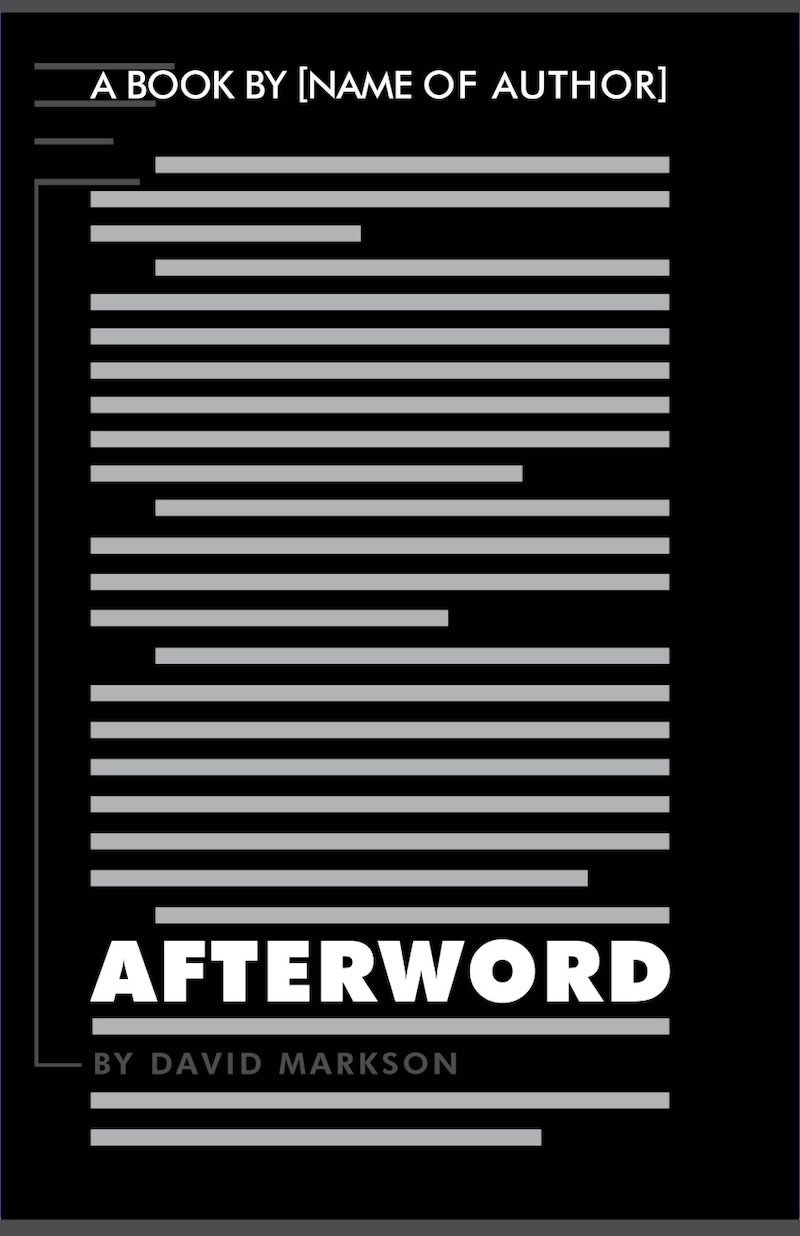
Afterword, by David Markson by [Name of Author] (Inside the Castle, 2025) is an odd little book at best. David Markson, one of my all-time favorite authors, passed away in 2010, so I was confused, but intrigued. Clearly Markson had not written a new book, so someone was channeling him. I love this particularly postmodern blending of the real with the not so much, several names come to mind (e.g., J.G. Ballard, Bret Easton Ellis, Jim Carrey), and as the promo copy reads, “in the lineage of false literatures like Pale Fire.” Another favorite. The cover design alludes to the cover of Gérard Genette’s Paratexts: Thresholds of Interpretation (Cambridge University Press, 1987), yet another of my favorites.
Jim Carrey and Dana Vachon start their book Memoirs and Misinformation (Knopf, 2020) with the line, “None of this is real and all of it is true.” In the preface to his book Doom Patrols (Serpent’s Tail, 1997), Steven Shaviro explains that it is a work of theoretical fiction because he treats “discursive ideas and arguments in a way analogous to how a novelist treats characters and events.” He goes on to write, “Each chapter of Doom Patrols is headed by a proper name. But these names are themselves fictional, even when they ostensibly refer to actual individuals.” Markson did all of the above in his later novels (Wittgenstein’s Mistress [Dalkey Archive, 1988], Reader’s Block [Dalkey Archive, 1996], This is Not a Novel [Counterpoint, 2001], Vanishing Point [Shoemaker & Hoard, 2004], and The Last Novel [Shoemaker & Hoard, 2007]), and [Name of Author] does it here as well.
I cornered the consciousness behind the lack of author of Afterword (no, it’s not AI) and asked a few questions.
Roy Christopher: Can you clear up what appears to be an intentionally confusing release. You are [Name of Author] and this book is called Afterword by David Markson. Why is this the case?
[Name of Author]: It was intentionally confusing to problematize authorship (ego rupture—more Deleuzian than Marksonian, its aggressive unoriginality is a conceptual nod more to James Merrill than Markson), not to lure readers (I tried to find a way around this sort of confusion, but no title worked for me except this one). It was about the who/what authors a book (and who we are as “people of the book.”)
RC: Moreover, Afterword is obviously informed by Markson’s allusive, aphoristic style, but the cover is a visual nod to Gérard Gennette’s Paratexts. Why these guys? Why these texts?
[NoA]: Had a vague notion I’d seen that cover before, but didn’t notice until you noted. John [Trefry at Inside the Castle] did the cover, and Genette seems an obvious choice for a direct reference, but I’m not sure why he never mentioned it to me (Maybe he thought I immediately recognized it? Maybe he doesn’t realize he ripped it off? That would be perfect. The book’s also about the all-been-done exhaustion of the Arts. Or maybe he did mention it, and I’ve forgotten?)
RC: Gennette’s work deals largely with the place of the author and Paratexts takes as its subject the peripheral texts that surround a book: prefaces, forewords, titles, illustrations, reviews, and, yes, afterwords. John said, “I Just liked the idea of doing something graphically that related to the concept of the afterword.”
Anyway, admittedly allusions are one of my areas of research, so they stick out to me first. That’s already a lot of references stacking up. How many is too many?
[NoA]: Your question suggests Afterword contains many too many, which I more or less agree with —there are a few strands interwoven (chapter-broken by trivial non sequiturs), but it’s subtle and dependent on seeing what the book is (and isn’t), which I can’t honestly say I would have been any more patient with/receptive to (as a Markson devotee), so I’m fine with the reception (among the dozen or so readers of Afterword) having been: sacrilege, scam, or pointless overkill.
In fact, it’s apt. May have been what I was going for?
RC: When I think of probematizing authorship I think of Markson, of course, but not before I think of the cut-ups of William Burroughs and Brion Gysin, and the proto-punk “plagiarist” practices of Kathy Acker. Afterword does its work in several ways along several vectors, but your anonymity as the author is the door into all of it.
To me, Allusion could be the first step toward an authorless literature. Does Afterword open writing up to new forms or perceptions of authorship? If it achieved its goal(s), what would follow?
[NoA]: Though I don’t have goals (I know that’s not quite what you mean), yes, authorless literature — not quite death of the author, but death of authorial identity/ego in favor of a collectivity of the author (a sort of Jungian author? Oh god, no, or maybe yes?).
As for whatever would follow, I don’t know, but yes that would be the question I would consider if I considered that sort of question. I used to, but ended up writing manifestos and taking myself too seriously, so now when I hear myself talk about my work I want to punch myself in the face, which is why I stopped doing readings and am such an uninteresting interviewee.
But hopefully these answers were helpful, and I appreciate the questions (which demonstrate your engagement with the book my closest friends and I wrote).
Afterword, by David Markson by [Name of Author] is available from Inside the Castle via Asterism.

I marshal the middle between Mathers and McLuhan.
Author of The Medium Picture (UGA Press, 2025), Post-Self (Repeater, 2025), and Dead Precedents (Repeater, 2019), among others; Editor of Boogie Down Predictions (Strange Attractor, 2022) and the Follow for Now series.