
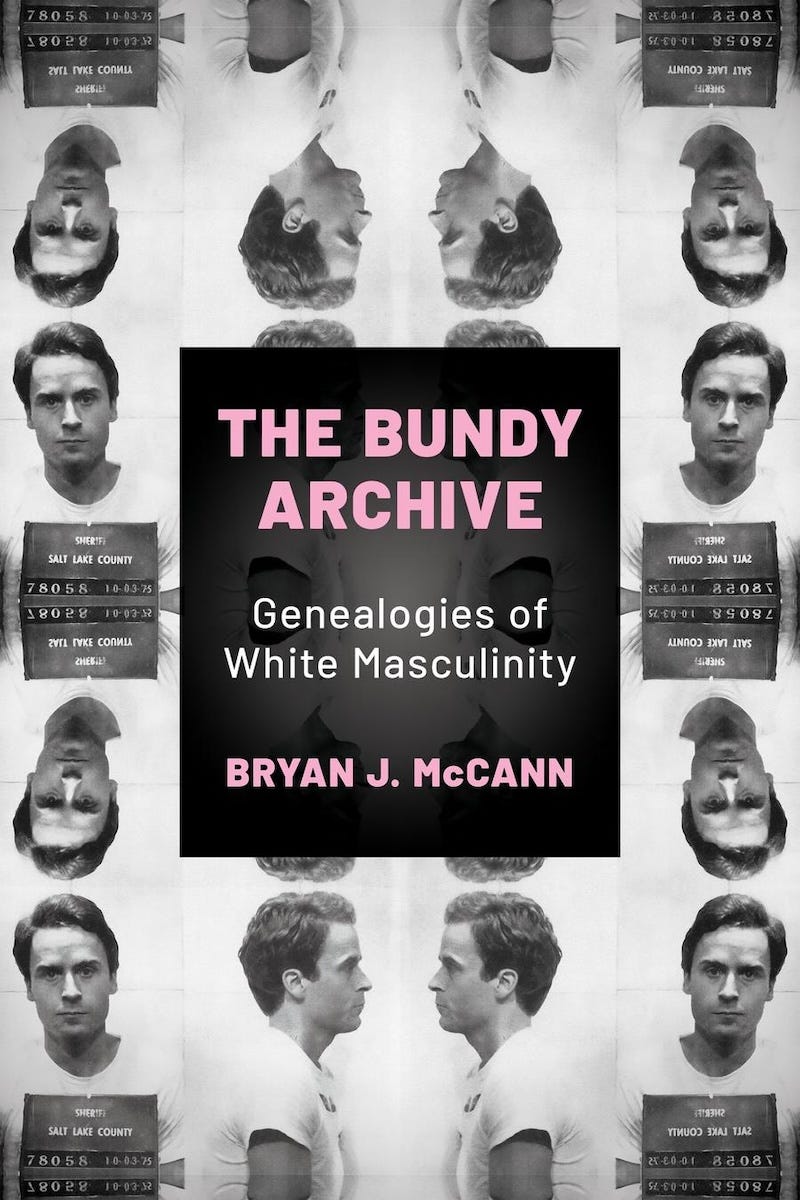
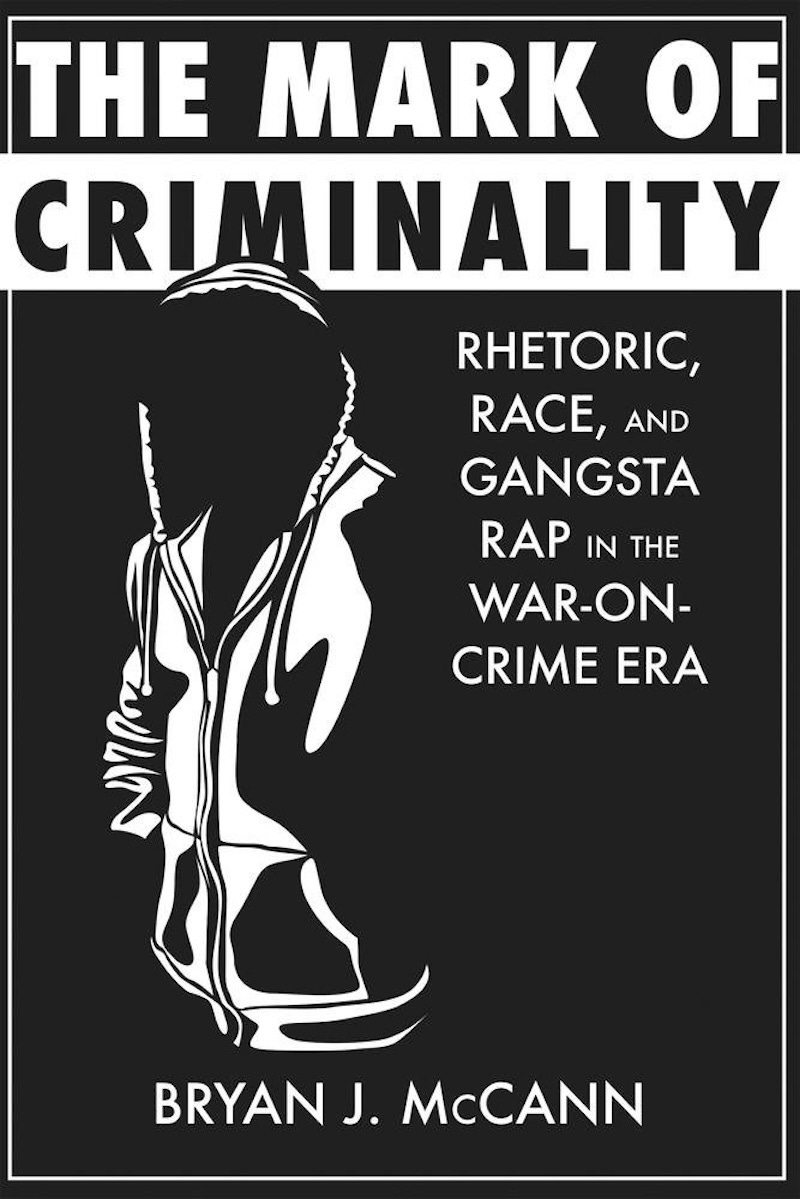
Of all the unlikely evergreen subjects, famous serial killers might seem the most unlikely, yet there are new media about the big ones—and Ted Bundy certainly is one of those—every year. With The Bundy Archive: Genealogies of White Masculinity (University Press of Mississippi, 2026), Bryan J. McCann has exhumed Bundy to explain the relationship between masculinity and violence, among many other things. Bryan and I were briefly colleagues at the University of Texas at Austin: my first year there was his last. During that time, I heard him discuss his dissertation, “Contesting the Mark of Criminality: Resistance and Ideology in Gangsta Rap, 1988-1997,” which became the book The Mark of Criminality: Rhetoric, Race, and Gangsta Rap in the War-on-Crime Era (University of Alabama Press, 2017), on several occasions, both formal and informal.
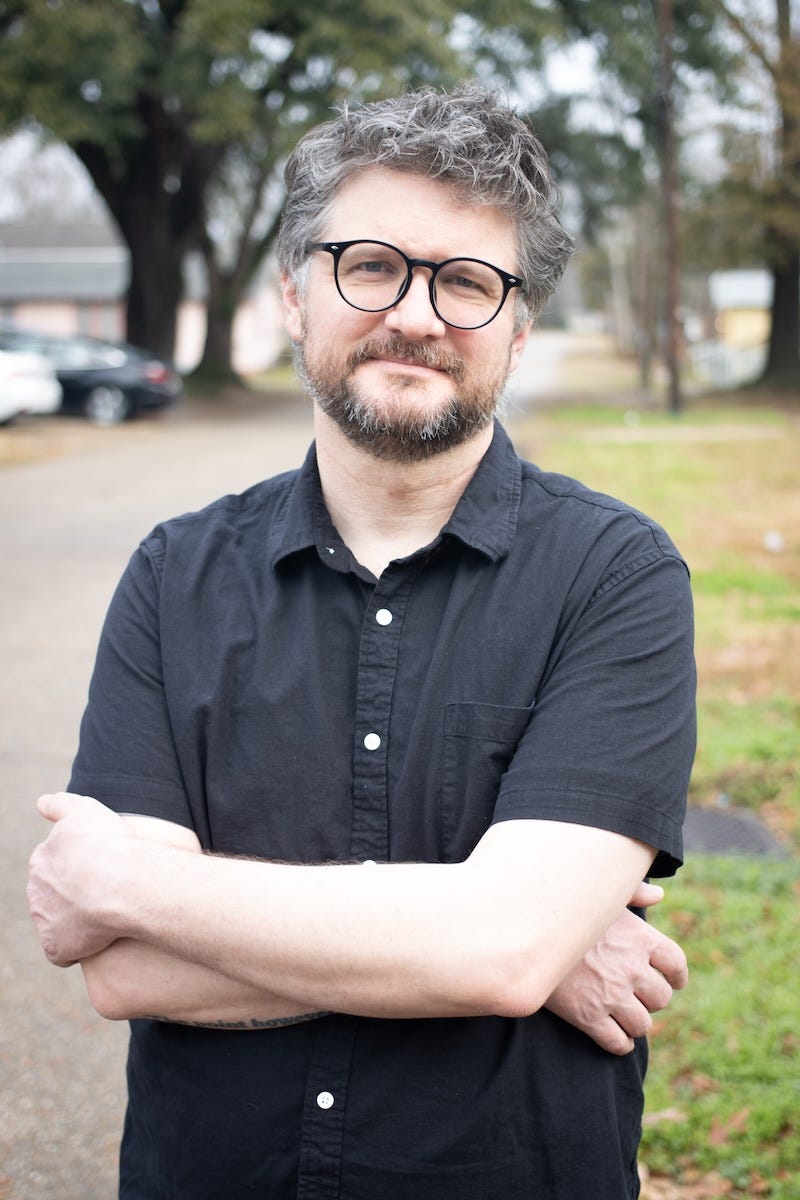
His latest, The Bundy Archive, is the first book-length academic work on serial killer Ted Bundy.
Roy Christopher: Why are serial killers such an evergreen topic? Why do they have such a hold on us?
Bryan McCann: The answer to this question hinges on who the “us” is. Something I argue in the book is that, while I claim that “we are Ted Bundy,” the “we” in question is not a royal one. Nor is there a universal “us” when it comes to serial killers such as Ted Bundy. Overall, there’s a variety of reasons folks flock to these tales. Some are interested in the psychology of these people. While the book itself doesn’t venture into the question of why women, and white women specifically, are so attracted to true crime about serial killers, I do think some common themes include the resonance of stories regarding violence against women, as well as the sometimes contradictory intricacies of disgust and desire. The argument I make in The Bundy Archive is that Ted Bundy and his ilk are so enduring in public culture because they give expression to normative ideals regarding gender performativity. While the standard tale of serial killers is that such murderers are perversions of masculinity (or, in rare cases, femininity), they actually enact a patterned logic of violent possession that structures normative white masculinity in general. The cultural scaffold that enables men such as Bundy is the same one that sustains colonization, enslavement, domestic violence, date rape, etc. Thus, part of the reason serial killers “have such a hold on us” is that they reflect “us” back at us—but typically in ways that minimize our own implication in the kinds of violence they perpetrate. Hence, we characterize men such as Bundy as monsters rather than mere humans. If they are humans, they are one of us.
RC: I know the answer to this from our brief time together at UT, but tell us how you got from gangsta rap to a serial killer, from N.W.A. to Ted Bundy?
BM: The transition from gangsta to Bundy is, in many ways, a fairly straight line. To be clear, I’ve long had it in the back of my mind that I wanted to write something about serial killers. I’m a product of the 1990s after all, which means popular texts such as Silence of the Lambs and real-life cases such as Jeffrey Dahmer loomed large. Of course, gangsta rap also loomed large in the 1990s, as did the proliferation of harsh penal policies and militarized policing tactics that disproportionately targeted Black and brown communities. But in terms of my writing trajectory, a lot of this played out in the classroom. As you may recall from our conversations in graduate school and the book, The Mark of Criminality: Rhetoric, Race, and Gangsta Rap in the War-on-Crime Era that grew from my dissertation, my interest in gangsta rap was in the ways rappers mobilized Black criminality to expressive and commercial ends. In other words, gangsta, as a Black vernacular practice, revealed the contingency of categories such as “criminal.”
Since finishing my doctorate, I’ve often taught some variation on a class I now call “Crime, Communication, and Culture.” I still have students read a chapter from The Mark of Criminality, and we discuss the different ways communities use rhetorics of crime and violence. Over time, I began pairing this unit with the readings on serial killers, which, drawing especially from David Schmid’s work, explore how serial killers function as celebrities in US culture. What evolved from this pairing was a sustained discussion of how the figure of the criminal, in texts ranging from Robin Hood to NWA to Ted Bundy, is quite flexible within the contingencies of public culture. So, a key way I see the two projects being related is that they attend to the ways crime finds expression through communicative modalities other than orthodox tough-on-crime rhetoric. Furthermore, the juxtaposition of gangsta rap and Ted Bundy is fascinating in what they reveal about the racial politics of masculinity. The cultural and political backlash against gangsta rap, I argue in The Mark of Criminality, was part of a broader historical contempt for Black masculinity. Black men performatively embracing criminality was something that culture warriors and elected officials needed to discipline, making such attacks a continuation of a historical genealogy that also includes lynch mobs. Serial killers, as my book’s subtitle suggests, have something to tell us about white masculinity. For instance, I argue in the book that the frequent claim that Ted Bundy did not “look like” someone who would kidnap, rape, and murder young white women and girls betrays the implication that mainstream publics know who does “look like” such a person. Historically, such a figure is the violent Black masculine rapist, an archetype that gangsta rap critiqued and enacted in provocative ways.
RC: Is masculinity, especially white masculinity, inherently violent?
BM: Masculinity is not inherently violent, but white masculinity is. Something I describe in the book is the degrees to which I encountered pushback on this project about its alleged essentialism. How could I say that all white men are ultimately the same as Ted Bundy? Of course, I am not saying that. As a white man myself, I really hope we’re not all like Ted Bundy! Although in the book itself, I certainly hold myself to kinds of scrutiny that suggest the gap between him and me is not as wide as I would hope. But, more importantly, the book is not making claims about white men per se. Rather, white masculinity is a historically constituted category of performativity. It is a modality through which gender finds expression. And its genesis is western modernity, which is a cultural, economic, and political project whose conditions of possibility include colonization, enslavement, and genocide. One cannot find a normative ideal of white masculinity—provided one is thinking about whiteness and masculinity historically—that is not predicated on violent control and possession. This does not mean all white men are violent sadists. Nor does it mean that only white men can wield the cruel forces of white masculinity. For eight years, a Black man was Commander in Chief of the most violent military in the world whose every fiber is cultivated by white masculinity. And the most prolific serial killer in the US was a Black man named Samuel Little. Despite not being a white man, my contention is that the violence Little enacted was a function of white masculinity’s legacies.
RC: In the book, you frame the serial killer “more as a process than a phenomenon.” Can you briefly explain that approach?
BM: In making this claim, I’m indebted to the work of Michael Calvin McGee, who is an influential figure in rhetorical studies, which is my primary field of study. To say this about serial killers is to claim that such murderers are not necessarily empirical facts. Yes, we obviously have people who kill strangers in a serial fashion and are therefore, in a criminological sense, serial killers. But how these folks show up in public culture are not consistent with this definition. Public media about serial killers often includes references to men such as Ed Gein, Charles Manson, or Richard Speck, none of whom were serial killers in the strictest sense of the phrase. But, I argue, they were definitely serial killers in a cultural sense.
On the other hand, the British doctor Harold Shipman killed over 200 people with opioids but does not appear as prominently in the serial killer lexicon as Gein, Manson, or Speck. In fact, while Shipman appears on Wikipedia’s “List of Serial Killers by Number of Victims” page, his entry falls under the separate category “Medical Professionals and Pseudo-Medical Professionals.” Ultimately, there is something far more “serial killer” about Gein making clothing and furniture out of human bones and skin (and, in so doing, providing a template for many fictional serial killers such as Buffalo Bill from The Silence of the Lambs), even if he killed “only” two confirmed victims, than a doctor discretely poisoning over two hundred patients with heroin. And this is to say nothing of the scores of innocent people nation-states such as the US have historically murdered on a serial basis through military and economic violence. As the kids say, serial murder is more an ineffable “vibe” than a discrete category. It is the function of a collective process of meaning making.
RC: What are you working on next?
BM: Presently, I’m following two trajectories that also show up in The Bundy Archive. The first is trying to publish more work that attends to the communicative and cultural politics of addiction and mental health in US culture. As I explain in the book, I’m a recovering alcoholic who grew up in an alcoholic home. Such work includes critiquing the norms of our alcogenic culture and considering how centering the experiences of people with addiction and mental illness frame our understandings of institutions such as US higher education. Second, I’m currently thinking through the persistence of Hannibal Lecter in US culture. The idea occurred to me during the 2024 election when Trump kept referencing Lecter in his campaign speeches. That, coupled with my experiences showing Silence of the Lambs to students in my course about serial killers, spawned a curiosity in Lecter’s broader cultural relevance.

I marshal the middle between Mathers and McLuhan.
Author of The Medium Picture (UGA Press, 2025), Post-Self (Repeater, 2025), and Dead Precedents (Repeater, 2019), among others; Editor of Boogie Down Predictions (Strange Attractor, 2022) and the Follow for Now series.