
We’ve all heard and had so many conversations about and with large language models lately. They all seem to be running over the same ground, too. It’s exhausting.
Leif Weatherby is the founding director of New York University’s Digital Theory Lab and Director of Digital Humanities. His research focuses on literary theory, digital culture, and the history of science. Special issues of concern are dialectics, semiotics, the nature of data and computing, and problems of political economy after the Industrial Revolution. But he also does some deep work on and thinking about AI models.

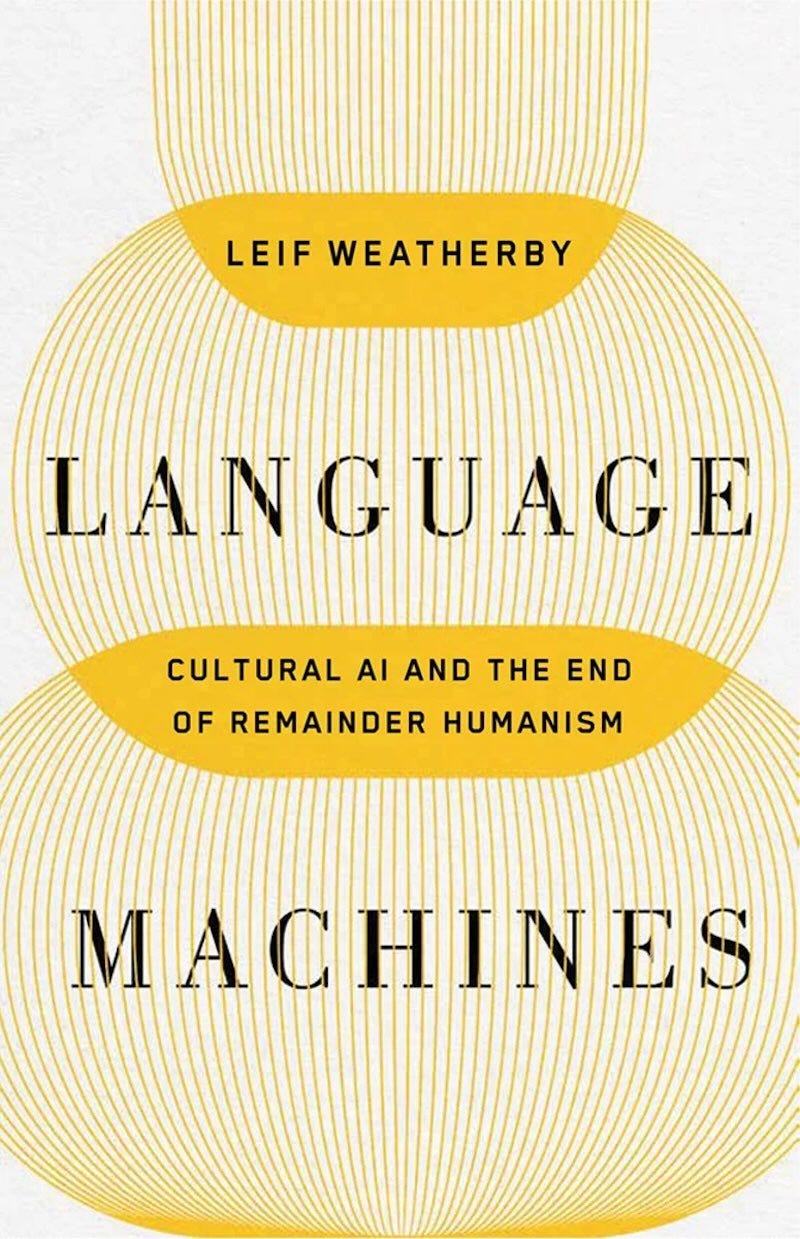
Weatherby’s latest book, Language Machines: Cultural AI and the End of Remainder Humanism (University of Minnesota Press, 2025), is a welcome and refreshing read among the recent glut of books about AI. I thought a conversation with him might yield us all some much-needed insight.
Roy Christopher: At this stage in the evolution of AI, is all the hand-waving and hand-wringing warranted?
Leif Weatherby: Yes. What we’re currently calling “AI” bootstraps the entirety of the sprawling digital knowledge complex and makes it distribution relevance-searchable in ways that we haven’t explained yet. That means if you touch a computer for some material reason in your job, your job is going to change. If you use a computer for something you consider important during your day, your day is already changing. The balance between memory and task is being upended, before we had a really good chance to absorb how it had already changed because of the rise of digital data storage devices and networks, followed by the massive expansion of deposited knowledge in them.
However, both the waving and the wringing are pretty devoid of illuminating sentences, so far. The wavers think that this time the technology is so good (or bad?) that it’ll solve all the problems that previous technologies did not, presumably because we used them incorrectly; or it’ll kill us all — hard to follow this thinking, if it can be called that. The wringers have a problem they’ve had for a while: is this a new form of Bad Thing, or an Extension of the Already Bad Thing? This matters because if you think the second thing, you might be further to the left and want a much more systemic change, but if you think the first thing, you can get all kinds of headlines and book contracts and profiles. Very bleak intellectual situation.
RC: Is it even fair to call this stuff “intelligence”?
LW: John McCarthy used the term “intelligence” as a goal in his write-up of the proposal for the famous Dartmouth program in 1956. if you think of intelligence as the regulative idea of this stuff, it’s fine (just like if you think of “cognition” as the object that cognitive scientists want to capture, not the one they have, it works). Because of this history, AI and cog sci have various definitions of what counts as intelligence, cognition, etc. These inform technical accounts of evolutionary biology and psychology, behavioral science, what have you. According to these very precise and restrictive definitions, any computing machine is approximately cognitive, and neural nets trained on all that data I mentioned before display some qualities that meet the definition of “intelligent” (given a goal, they can find a way to it even if some attempts are blocked: adaptive, flexible, etc.). I hear skeptics saying aha, but that is a ploy, that is not what ordinary people using ordinary language mean by “intelligent.” Fine, but the hypesters come back with, “well, ordinary people experience LLMs as ‘intelligent’, don’t they?”
I think this conversation is a dead end. If you say “intelligent,” you are begging a specific kind of metaphysical question. Look at the parallel case of “smart” technology — we use the term, but we don’t care as much anymore. Perhaps we’ll start saying that machines are “intelligent,” but stop thinking that’s responsive to the deeper question, which is “what is thinking?” But this might not be so surprising in historical context: intelligence was the direct predecessor to the term “information.” We still use the term this way for spycraft, or intelligence services. Machines are “possessed of intelligence” in the sense that they store knowledge, of course — and the big deal about AI’s current phase is that it makes that knowledge so accessible that no one can tell what the truth is in it (but this is not new either).
RC: In Language Machines, you write “language models capture language as a cultural system, not as intelligence.” Can you elaborate on this very important and overlooked distinction?
LW: It’s not so easy to tell where intelligence and language leave off from one another. Noam Chomsky’s long-dominant account of language puts it heavily on the side of the intelligence. For him, humans are infinitely creative with finite means, generators of both any possible valid type of sentence and also the truth, and morality. But there’s evidence that language and reasoning are separate, too — both evolutionary biologists and neuroscientists suggest that we can see them operating in different mental theaters, as it were. LLMs, I think, show us two things about this. First, they spread a cultural-language distribution out in such a way that we can see far more of its extent than we ever have before, at least in the context of quantitative systems. This system isn’t generated by logical inference, it isn’t “intelligent” first and then later picks up some language tricks. It’s words first (well, tokens, subwords, etc.), and then later (starting in about 2022), we torture it until it gives us something that looks like logical or other more strict symbol systems that range over all that linguistic content.
The result is a precision-guided context machine, and in its most native context (computer languages) it’s alarmingly agile. From my perspective, that means we’ve taken a very wide distribution of meanings we deposited in text (and other media) online, and made it active in solving the types of problems and tasks that that very medium already is in charge of in so much of our infrastructure and knowledge work. No one saw that coming, because both the knowledge production and the infrastructure depended for their genesis on the exclusion of “culture” in many ways, but once enough of it was in digital form, maybe it’s not so surprising that it can be harnessed in this way. maybe one way to put this is: from the beginning, cybernetics, computer science, and cognitive science were sort of small-scale invasions of the proper territory of the humanities: culture, symbols, signfication brought into technological and mathematical form. But now, we have all that extensive cultural stuff brought into virulence and we see everyone casting about with humanities questions: what does it mean? It turns out culture doesn’t carry its own interpretation inside of it automatically.
RC: Can you briefly describe what you call remainder humanism in the book?
LW: I kind of made this term up in anger, at the critics’ inability to grapple with what was really going on. I think a lot about the great classics of humanistic internalization of modern science: Eddington, Arendt, Cassirer. Kant’s whole system of philosophy is a reaction, if you want to think of that way, to Newton. If we humanists have a tradition in the modern period, it is one of reinterpreting the world given how much more deeply we know it, over and over again. To do that, you have to know what’s happening at a tolerable level of precision (without making your entire intellect just an imitation of scientific precision instruments).
When I was composing the book, I couldn’t think of a single example of that. It just seemed that everyone was shrinking from the task. (maybe the needle has moved a bit since 2023.) Just saying, “well, if a computer can do it, it’s not really what it means to be human anyway.” I found this pattern went back to Hubert Dreyfus’s critique of symbolic AI in the 1970s, and I don’t think it’s a good basis for figuring out what’s going on with AI now. I like to use the image of painting oneself into a corner, and the last straw is language — it’s just absurd to say that language isn’t the essence of human being. Of course, if you can’t think yourself out of this, you end up saying that LLMs only produce “synthetic language” — a real clinker, as philosophical terms go, since language is synthetic.
I’ll add: if you think about my response about intelligence, you can see one of the angles critics have taken in responding to me so far: “Aren’t you, Weatherby, being a “remainder humanist” with respect to thinking?” Maybe. The term wasn’t meant to suggest there’s no core to human being, but you have to admit that one of the major features of our species is a form of shared task-making. Auxiliaries of thought are thousands of years old. Generative language models are not.
RC: Tell us about The Mismeasure of Mind: Against the Prediction of Everything. This sounds unique and germane.
LW: This is a book I’m working on now about optimization and prediction. it takes the form of a modern history of a particular form of probabilistic reasoning called Bayesianism, named for the 18th-century pastor Thomas Bayes. Rather than thinking of probability as something you derive from experience or data, the theorem Bayes created (and which was formalized by the scientific giant Pierre-Simon Laplace in the 19th century) inverts the question. How likely are you to have seen what you just saw, it asks? What hypothesis, explanation, or cause, is best to bet on as having shown you the world the way you perceive it now? As you can see, this is a pretty deep type of question, and it has a long religious history (how likely was the Resurrection?). But it also plays a sometimes understated but central role in the actual data-optimization game we’ve been playing since just after World War II. It belongs to — and is often used as the example of — the type of algorithm that has become the infrastructure, the bureaucracy, of modern life. I call this Bayesian Bureaucracy, and I describe it alongside the Bayesian Mind Virus, which is when you let it stop being a tool and use it as an Explanation for Everything. This tendency is nowhere more visible than in Silicon Valley, where the Rationalist cult led by Eliezer Yudkowsky, Scott Alexander, and their ilk provide the mythology or the worldview of total optimization. My argument is that this tendency is anti-humanistic, anti-democratic, and nihilistic. In fact, I think it is the perpetuator of what I think of as Really Existing Postmodernism.
RC: What are you working on next?
LW: Mismeasure, but also a lot on reasoning and language models. The Digital Theory Lab is producing some data-scientific work in interpretability. I think the humanities has an incredible chance to step back into the void of interpretation left behind in the wake of all this “progress,” but not as deep a bench as you’d want to play with. So that’s where we (and I) are trying to intervene.

I marshal the middle between Mathers and McLuhan.
Author of The Medium Picture (UGA Press, 2025), Post-Self (Repeater, 2025), and Dead Precedents (Repeater, 2019), among others; Editor of Boogie Down Predictions (Strange Attractor, 2022) and the Follow for Now series.